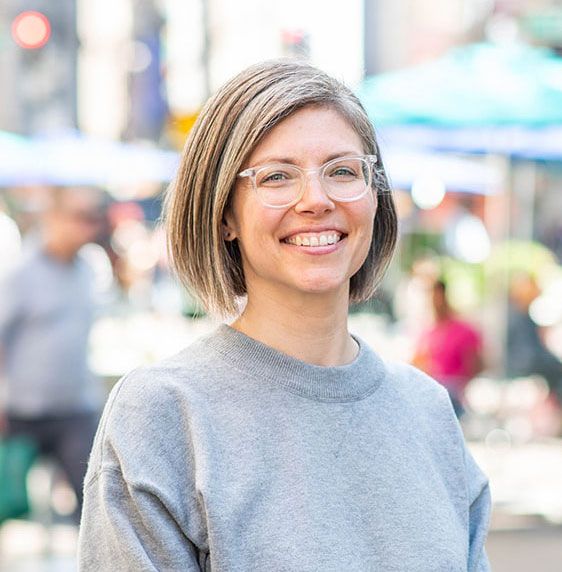
In Emily Weidenhof’s ideal city, streets would be designed centering people, not cars. As assistant commissioner of Public Realm at the New York City Department of Transportation, where she has worked for the past 16 years, she has been turning this vision into reality by reimagining how urban asphalt can be transformed into public space.
“For many New Yorkers, their streets are their front yards,” says Weidenhof ’04 A&A. “Our streets have been overdesigned for vehicles for decades, and so there is a tremendous opportunity to partner with communities to reimagine this infrastructure to ensure that all New Yorkers have access to high-quality public space in their neighborhood.”
Weidenhof is not only redesigning streets to make them safer for walkers and cyclists, she is also helping the city create programming that fosters community and benefits the city’s economy. One recent analysis showed that New York City streets pedestrianized during the COVID-19 pandemic experienced a retention of existing businesses, a greater growth in new businesses, and higher sales than similar corridors without open streets.
“We see that creating welcoming and vibrant public spaces where people can linger and gather brings huge economic value to our city and contributes to thriving communities,” Weidenhof says.
Her interest in urbanism was sparked during a semester abroad in Rome.
“Being able to walk through this amazing environment that had been shaped over thousands of years shifted my focus from buildings to streets—some of our most valuable public spaces,” Weidenhof says.
After graduating from Penn State, Weidenhof earned her master’s degree at Columbia University’s Graduate School of Architecture, Planning and Preservation. At the NYC DOT, she has also played an integral role in implementing the Broadway Vision Plan, which has converted the city’s famed corridor—from Union Square to Columbus Circle—into a pedestrian’s paradise. —Lauren Ingeno, ’13 Com, ’13 Lib