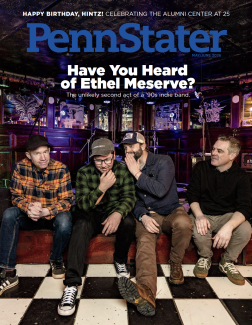
They needed a van for touring, and they found one through a newspaper classified ad, which in the mid-1990s was a normal way to find things. They drove a few miles out of town to meet the seller, knowing almost nothing about the vehicle other than that it fit their minuscule budget. “I don’t think we even took it for a test drive,” Ryan Gerber says.
Gerber ’96 Eng and his bandmate Josh Vargo handed over the agreed-upon $450 in cash, and Gerber got in the driver’s seat for the drive back to State College. They were on a narrow mountain road when the snow started, at which point they understood that the van’s tires were essentially bald and that its brakes did not, as a practical matter, work.
“I’ve got the brake pressed all the way down, but it’s barely slowing down, and I’m just sweating, white-knuckled, gripping the wheel,” Gerber says. “We come to a four-way intersection, and it’s not stopping. We finally end up in a field and come to a stop. We are so lucky we did not die.”
The memory is vivid, if not exactly fresh, the sort of near miss you can laugh about a few days or 30 years later. For nearly anyone who ever played in a college band that managed to get off the ground, however briefly, the legacy is just that: the stories, memories of a shared experience, of road trips squeezed into vans of dubious roadworthiness, of nights spent creating something, however fleeting, filling a smoky bar or a sweaty basement with noise, motion, and life. A few manage to stick together beyond graduation, at least for a while. What doesn’t happen—what seems almost impossible—is a band getting the chance to pick up, after nearly three decades, almost exactly where it left off. To not just play together again, but to actually tour, to see their catalog reissued, and maybe even make new songs.
And yet there were Gerber and Vargo and Chris Baronner ’00 Lib and Jeff Bundy ’01 Com, all of them in shouting distance of their 50th birthdays, on stage on a frigid night this past January. They were crammed into the corner stage at a former bar-turned-all-ages music-space in downtown State College, churning through decades-old songs for a few hundred friends, family, and old and new fans. A few weeks later, they were in Japan, playing to packed houses on the other side of the world. Their band is Ethel Meserve, a legendary-to-some State College indie rock collective enjoying the unlikeliest of second acts.
“It’s been overwhelming,” Baronner says, “but I always knew we could get back together. It wasn’t like we kept trying and failed; we waited until the right moment. It was a pipe dream, until it wasn’t.”
BLASTS FROM THE PAST: Top, tearing through the set during a 1998 show in Denton, Texas; bottom, a flyer for a benefit show at University Park, presented by campus radio station WKPS. Courtesy.
If Ethel Meserve is very much a collaborative entity, Baronner is the keeper of its flame, the member whose life has been most consumed by music—the sound, certainly, but also the scenes, those organic communities that evolve to signal a music’s place in the broader culture and produce the ephemera that document its history. Baronner is a lifer, an obsessive documentarian and collector, and for all that he’s immersed in the scenes of which Ethel Meserve played a role, he knows most people have never heard of his band. It’s a quality shared by nearly all the bands that influenced Ethel Meserve, and thus a mark of pride. Getting back together was never about money or fame, goals they’d never had in the first place; it was a chance to create more memories, and to confirm a hunch that those memories resonated for anyone else.
They were State College townies, Gen X kids who hung out and rode skateboards, and who watched MTV until more interesting musical options emerged. Downtown and around campus, the skate scene was the rare space where older and younger kids might mix; Gerber, whose parents both worked at Penn State, was a few years older than his future bandmates; he remembers driving around town as a State High senior with his good friend Mark “Mordil” Morrison; Baronner was the diminutive freshman in the back seat, gently picked on and looked out for in equal measure.
Music was an essential component of the scene, and the skaters tended to gravitate to music that mirrored their passion: challenging, noisy, and demanding a certain level of commitment. Both appealed to Baronner: His mom, Wanda Baronner Pluto ’82 A&A, tended bar for a time at the Phyrst, and he grew up immersed in the sounds of the bands that were fixtures at downtown establishments in the 1980s and ’90s. It was in middle school that he started hearing the bands that would set him on his way: an array of punk or punk-adjacent bands with sounds (and sometimes names) unfit for commercial stations but perfectly suited to college radio.
And then there were the shows: The 1980s brought an explosion of bands who took a do-it-yourself approach to recording, releasing, and performing music that typically fell under descriptives such as post-hardcore or indie rock; in the process, they created a cross-continental network of places to play, and couches on which to crash. In State College, that meant gigs at the HUB or the VFW, at the Wesley Student Center downtown, and at local house shows, venues that didn’t sell booze and were open to all ages; by the time he was in ninth grade, Baronner rarely missed a show. “The people skating in the alley behind Playland were the same people hanging out at the VFW when there was a show,” he says. “But even before we were playing together, it was me and Gerb and Mordil driving around to skate spots, listening to Fugazi and Pixies.”
Fugazi in particular inspired what came next. The Washington, D.C., band stands as the defining group of the early post-hardcore sound, as famous for their ethos—inclusive, emotive, and fully self-sufficient—as for their music. Fugazi built a zealous following in part by encouraging kids to do more than just follow their band, but to form their own bands, start their own labels, and book their own tours. Barely four hours away, the skate kids in State College got the message.
Baronner learned guitar mostly by playing acoustic in a high school youth group at the local Presbyterian church, where he met and befriended another musically minded kid named Jeff Bundy. (If that surname rings a bell: Bundy’s father is former Blue Band director O. Richard Bundy ’70 Edu, ’87 DEd A&A.) The two friends would eventually be bandmates, but Baronner’s first stint in a band came in the winter of 1993-94 with a group called Samuel; that lasted until spring break, when he says he was “booted” from the band.
Baronner responded by starting a band of his own, Wedge, which played exactly one show that June at State College Area High School. The lineup featured another friend from the skate scene, Jesse Fritsch, and a talented New Jersey transplant named Josh Vargo. Of the current Ethel Meserve lineup, Vargo is the only member who didn’t grow up in town and the only one who didn’t end up at Penn State. At the time, Baronner knew him simply as “this ‘wonderkid’ with a shaved head who just rips on the drums.”
Wedge wouldn’t last the summer. Fritsch was increasingly focused on making it as a professional skater, which he eventually did; just that quickly, the band was finished. But Baronner and Vargo decided they weren’t done playing together. They brought Gerber into the fold as a second guitarist and recruited another school friend, Andrew Simpson, to play bass. They would bring the beginnings of a few songs, but this would be a new band. And that band would need a name.
So, about that.
Practically anyone who lived in State College in the second half of the 20th century recognized the name Ethel Meserve, whether they actually knew the longtime local resident herself or simply the eponymous gift shop—a fixture on the downtown business scene for nearly 50 years—of which she was proprietor. Baronner was certainly familiar. He was in high school when he got a part-time job at the old Graham’s Newsstand and ice cream counter on Allen Street; when business was slow, he could gaze out the window and across the street to the awning where “Ethel Meserve” was written in evocative midcentury script.
A side passion for Baronner is Forgotten Valley, a Facebook page he started in 2019 as a way to document late-20th-century State College history and culture. He’s learned a lot about the woman whose store inspired the name of his band: Born in 1899, she died in 2000. In the three centuries her life spanned, she became one of the first female business owners in Centre County. She was known for throwing legendary parties, and in her 90s she was the subject of a feature in the Philadelphia Inquirer about women who took up weightlifting late in life.
Absolutely none of which Baronner knew when he named his band after her.
“At the time, it was just, ‘There’s this awning across the street, let’s go with that,’” he says. “We got to meet her when she closed the store, right after we started using the name. She was cool—she didn’t understand why we were doing it, but she was OK with it.”
LAST TIME OUT: Bundy, Baronner, Vargo, and Gerber played the final show of Ethel Meserve’s ’90s run in August 1998 at Chicago’s Fireside Bowl, a famous stop for punk and indie bands of the era. Courtesy.
Newly named, Ethel Meserve—technically “Ethel Mezerve” at first, since they had misspelled their namesake’s surname on the band’s first flyer—got to work, playing its first shows in the fall of 1994. “I don’t remember a whole lot of conversations exactly,” Gerber says. “It was just us practicing and writing songs, and then Chris was like, ‘Hey, let’s book a show.’” A band dynamic took shape: Baronner and Gerber collaborated on most of the songwriting, sharing musical ideas and doubling up on vocals and guitar. Vargo, the kid in the group, provided a rhythmic foundation few of their peers could match. “Josh could play any of our parts,” Baronner says. “We always just marveled at his ability.”
Jokes Gerber, “We lucked out with Josh. The rest of us are just kind of hacks.”
But elite technical ability was never the point. It was more about creating an intensity of feeling, a sound suited to the packed basements where they often played. That sound, rooted in the influence of that D.C. post-hardcore scene, evolved over time into something more, defined by angular, repeating guitar riffs; intense, stop-start rhythms and changing time signatures; vocals more yelped than sung; and lyrics that were angsty, smart, and often all but impossible to make out. Baronner acknowledges that many of Ethel Meserve’s peers shy away from attempts at categorization, but he says he’s unbothered. “Call it emo, Midwest emo, math rock,” he says. “I don’t mind.”
Says Vargo, “To me, Ethel Meserve is math rock, but even now, it’s hard to put it in a category.”
For Ken Shipley, categories were beside the point. Shipley first encountered Ethel Meserve in the summer of 1995, around the same time he founded an indie label called Tree Records. A girlfriend played him the band’s four-song demo tape; not long after, he got in touch with Baronner to say he was interested in releasing a 7-inch single for the band. He saw them play in Philadelphia in the fall of 1995, then paid for a day of recording time at a studio in Baltimore.
“The State College scene they came from produced a very math-rock-forward sound, sort of the D.C. sound with a tinge of metal in it,” Shipley says. “I couldn’t tell you what really drew me to them. I just knew they were all really good players, and they were listening to the right sounds.”
That 7-inch vinyl single came out in May 1996; not long after, Ethel Meserve hit the road in earnest. Over the course of the next two months, the band (with old pal Jesse Fritsch back on bass) would play 30 shows across the country, a run that coincided with the end of Vargo’s senior year at State High. “I actually had to take my finals early—I think I was in Amarillo, Texas, when everybody else was graduating,” he says. “The only teacher I had who wouldn’t approve it was also a musician in town, but the principal overrode him. She thought it was great that we booked it ourselves.”
They had another van by that time, an old green Chevy G20 workhorse from the mid-1980s that Gerber and Baronner picked up at a Penn State surplus auction and put thousands of miles on over the next three years. They remember touring fondly as a chance to contribute to, and share in, a nationwide scene of like-minded young people bonding over music they created, on their terms. “We really didn’t have any bad experiences,” Gerber says. “We toured with other bands, had a blast meeting folks and hanging out with people. There were really good kids everywhere we went—it was a really good community. Everybody was supportive.”
Supportive, and generally well behaved. Just as their stripped-down sound and jeans-and-T-shirt stage wear was in part a revolt against the excesses of more mainstream rock and metal, their behavior on the road was a counterweight to the backstage debauchery made famous in earlier eras. Gerber recalls, “Our party level was pretty benign.” The closest they came to canceling a show came during a stop in Madison, Wis., after then-bassist Paul Hagin ’97 EMS consumed a dangerous amount of, well, baked goods. “There was a competition at a bakery to see who could eat the most blueberry turnovers, and he ate so many he could barely go on,” Gerber says. “He recovered, though. Everything was good.”
The closest they came to recording a full album was July 1997, when they planned a trip to New York to record at a studio owned by Fred Weaver, an old State College friend. The band climbed into the green Chevy and headed east on Interstate 80, but they made it only as far as Milton, Pa., about an hour east, before the engine threw a rod. They pulled over to find oil pouring onto the ground. Weaver drove out from New York in his own van to pick them up; figuring they’d more than gotten their money’s worth, the band left the Chevy in Milton where it had rolled to a stop.
They just made it back into the city before Weaver’s van died, leaving the band members to help push it through the streets of Manhattan before they made it to the studio. The six songs produced by that session were released in November 1997. They called the record The Milton Abandonment.
It’s impossible to know what they might have done beyond that; even before the recording sessions, Gerber and Hagin had both decided they were leaving for graduate school in California. But when The Milton Abandonment was released, Gerber suggested coming back to join the band on a final tour in the summer of 1998. By that time, Baronner and Vargo had started a new band with Bundy called The Great Northern.
“I’d played in a bunch of bands in high school that were Ethel Meserve–adjacent, and I was a big fan,” Bundy says. “At that point, I was just filling in for the tour.”
They played more than 40 shows in that run, the last coming in Chicago in August 1998, where an up-and-coming band from El Paso, Texas, called At the Drive-In was also on the bill. Two years later, ATDI would release Relationship of Command, widely regarded as one of the best and most influential rock records of the early 21st century. Ethel Meserve would get no such moment in the spotlight. Spelling the Names, which collected their demo tape, singles, and compilation tracks, was released by Tree Records in 2000, by which point Vargo had moved to California to pursue a career in music, and Baronner and Bundy were finishing their Penn State degrees. Much like that old green Chevy, they’d had a good run. Now it was over.
OLD BAND, NEW FANS: Sharing bills with other bands who came up in the mid- to late- ’90s indie scene, Ethel Meserve played to packed crowds during five shows in Japan in February. Taku Tatewaki.
But as Baronner said, there was always a chance. He’s spent most of his time since graduation in the music industry in Chicago and Washington, D.C., booking shows, working as a promoter and talent buyer, and for the past decade, curating A Town So Small, a digital archive of flyers, photos, zines, and recordings documenting underground music from the 1980s and ’90s. He remains steeped in the scenes he once contributed to, knows the bands who were Ethel Meserve’s peers and, in many cases, those who’ve come after and bear some sonic imprint of his band’s sound.
The bandmates had stayed in touch. Gerber was settled in Raleigh, N.C., where he works as an environmental engineer; Bundy had landed in Charlotte, N.C., where he’s director of client activation for Hearst Media Production Group. Vargo, whose two decades in California included stints in touring bands and eventually co-founding creative agency The Anton Eye with his old bandmate Jesse Fritsch, moved back to State College in 2021. Baronner had also remained tight with Shipley, who in 2003 had founded Numero Group, an archival record label specializing in reissues of often obscure artists from an array of genres and eras.
“I think I heard from Chris in 2023 that they maybe wanted to start playing shows. And it’s really about finding the right shows to play,” Shipley says. For a band reuniting after decades of dormancy, Shipley proposed a cautious reentry into performing: “Keep it limited, find the right shows with the right audiences.” Eventually, through a connection in Japan, where there was interest among fans eager for any connection to the 1990s Midwest emo scene, Shipley saw a fit.
THE BOYS ARE BACK: Vargo, Bundy, Baronner, and Gerber photographed in State College in January. Courtesy.
All the band needed was to actually get back together. Baronner reached out in early 2024 to gauge interest; finding everyone open to the idea, they convened in State College that summer. “I will say, after our first practice, I wasn’t sure we were going to be able to pull this together,” Gerber says. “We kind of fumbled through a couple songs; Chris and I couldn’t remember all our guitar parts. It was pretty rough.”
But they kept at it, and Shipley worked with the band on a plan to reissue their catalog through an array of physical and digital releases over the next few years. And they settled on a slate of shows, consistent with Shipley’s suggested path: They would start in Chicago in January at Several States, a one-day festival that Baronner created and booked with bands connected to the Midwest emo scene—including Samuel S.C., an updated lineup of the band Baronner had played with in high school, fronted by Vanessa Downing ’94 Lib and Dean Taormina ’93 Lib—followed by a hometown show in State College and a one-off the next night in Philadelphia. From there, it was off to Japan for five shows in 12 days.
And every show went great. Their Chicago set brought instant feedback from their peers; the State College show, held at Manny’s, a music venue in the basement space formerly occupied by The Saloon, gave them a chance to play for friends and family‚ including Bundy’s father, the former Blue Band director, who watched, all smiles, from the back of the room. “It’s not really my thing,” the elder Bundy said with a laugh. “But they sound great.”
In Philly, playing in a former-church-turned-music-venue where they had first played in 1995, they were on a bill with mostly younger bands and a very young crowd, whose energy brought Ethel Meserve’s members back to those mid-’90s house shows. And then Japan, where Jeff Bundy says, “We signed copies of 30-year-old singles every night.”
Baronner calls those two weeks in Japan “the best experience of my life—being with friends, doing something so meaningful, all the people who came to the shows.” It surely matters that it all happened when it did: They’re at points in their careers where they could manage the time off needed to make the tour work. They’ve also experienced life in ways that made it easier to appreciate just how rare, and how significant, this opportunity has been. “We’re coming into this as grown men who’ve been through a lot,” says Bundy, whose wife, Mary Travis Bundy ’02 Nur, died in January 2024. (He was joined on the Japan trip by his girlfriend, Katie; during a stop in Kyoto, they got engaged.)
There’s a good chance Ethel Meserve will book a few more U.S. shows this year—not too many, of course, but select dates in cities and at venues that make sense. They’re excited to keep playing together, and about the possibility of writing new songs. The collective expectation is no more complicated than enjoying it for however long it lasts.
“I love these guys,” Vargo says. “It’s great that you can know somebody for this long, even if we haven’t talked that regularly over 30 years, and you can come back together and feel like no time had passed at all. It’s such an awesome thing to be able to experience that. Music tied us together in a way, and you can’t really break that.”
Baronner worries a bit that he might come off as arrogant when he says the entire experience—both the reunion and its reception—“proved to me that what we were doing was important.” It’s an assessment offered in context, in the idea that what was important was the effort, the commitment they brought to creating something, and to being part of a larger community. “It was something lots of other bands were doing, and some of them got to continue doing it a lot longer than we did,” he says. “But things are cyclical. Music never goes away.”
Watch Ethel Meserve's Philadelphia 2026 show
Listen to an Ethel Meserve playlist
Submit a letter
We welcome reader feedback. Submit your letters to the editor here.
In the summer of 1869, Agricultural College of Pennsylvania President Thomas Burrowes invited alumni back to campus. Friends from the Class of 1866 enjoyed that reunion so much, they met again the following year to make official their lasting allegiance to one another and to the institution they loved. One hundred and fifty years later, the organization they founded has evolved to be the largest of its kind in the world, connecting alumni, supporting students, and helping lift the university to new heights.
It is a truth universally acknowledged: Wherever a Penn Stater goes in this world, be it for work or for fun, they’re bound to run into another Penn Stater. From cathedrals in Paris to palaces in London, from pool halls in Connecticut to hotel lobbies in Florida, from Bavarian breweries to the grandeur of the Taj Mahal, we asked you to share your memories of unexpected encounters of the blue-and-white kind. Like any Penn Stater hearing a “We Are …,” you knew just how to answer.