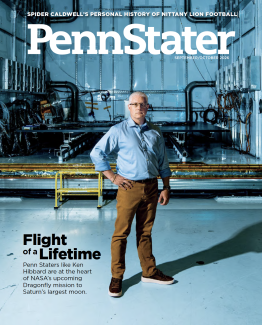
The science and engineering feats related to NASA missions in space are among the most technically complex, detail-oriented, and expensive of all human endeavors. But at their heart, they’re about a pretty simple thing: wonder. We wonder how life on Earth formed. We wonder what else is alive out there. And we wonder if we, too, could survive somewhere far from here.
A first-of-its-kind NASA mission called Dragonfly is set to launch toward Saturn’s moon Titan in 2028 to collect data for all three of these wonderings. And it’ll have Penn Staters’ fingerprints all over it.
Ken Hibbard ’96 Eng, Dragonfly’s mission systems engineer through the Johns Hopkins Applied Physics Laboratory (APL), calls it “the mission of a lifetime,” both because it’s a culmination of his 30-year career working on NASA missions, mostly at APL, and because of “the idea of humanity trying to understand habitability in our solar system and gain insight into how life developed on Earth, and Penn State having a key role to play in making that happen.”
Back in February 2016, Hibbard and a few of his APL colleagues were asked to dream up a proposal for a mission to Saturn’s largest moon, which has a thick, nitrogen-rich atmosphere and is the only other body in our solar system with stable liquids on its surface. Hibbard’s team needed something unique that NASA might see fit to add to its New Frontiers program. What they came up with was an octocopter drone, powered by a nuclear battery, that would look for evidence of the building blocks of life on Titan’s icy surface.
The idea sounded stellar as both a science-based mission and an engineering feat. In its almost 70-year history, NASA had sent rockets and rovers, manned spacecraft and unpiloted probes to explore our solar system. It had never sent a nuclear-powered rotorcraft the size of a car to fly around on a distant celestial body.
NASA/Johns Hopkins APL.
The APL team, led by principal investigator Dr. Elizabeth “Zibi” Turtle, had two immediate challenges. First was a considerable time crunch, as they needed to conduct a comprehensive feasibility study and submit their initial proposal in just over a year to meet NASA’s April 2017 deadline, rather than the multiple years they’d typically spend developing such a concept. But just as critically, APL had drone experts on staff but no one who knew enough about large rotorcraft to help them design what they had in mind.
Luckily, NASA has three university-based Vertical Lift Research Centers of Excellence in the country—one of them at Penn State. APL reached out to all three centers to gauge interest in the project, which had a giant caveat: NASA doesn’t provide funding to New Frontiers missions in the initial proposal phase. There wouldn’t be any money up-front to cover the costs of research and testing.
“Penn State was all in,” Hibbard says of their initial call to Ed Smith ’88 Eng, distinguished professor of aerospace engineering and founding director of Penn State’s Vertical Lift Research Center of Excellence. Hibbard had been one of Smith’s first students after Smith returned to his alma mater as a teacher in 1992. A quarter-century into his career in academia, Smith took the rotorcraft-in-space idea to three then-associate professors in his department—Jack Langelaan, Jose Palacios, and Sven Schmitz—who immediately leapt at the challenge.
MAN ON A MISSION: Ken Hibbard began working for APL in 2003, initially assigned to NASA’s MESSENGER mission, which was the first spacecraft orbit of Mercury. Cardoni.
The three of them met with a small contingent from APL at a restaurant near Baltimore in early 2016. “There were maybe 12 people there,” Schmitz says of the core Dragonfly team that would, over the next several years, bloom to more than 1,000 (including subcontractors).
Designing the rotors to fly a mobile science lab in a dense atmosphere that’s minus 180 degrees Celsius and has one-seventh the strength of Earth’s gravity was a giant puzzle. How many blades should they have? What shape, size, and speed will work best? How many rotors are needed? “The Penn Staters were great on the concept side because, as a university, they work in theory all the time,” Hibbard says. “They’re very free-thinking, have lots of ideas, and that’s very good in that phase.”
Schmitz designed the rotor blades while Smith worked on a conceptual design of the vehicle and its flight plan. Palacios ’03, ’04 MS, ’08 PhD Eng, an expert on rotorcraft flight in adverse weather, found ways to test Schmitz’s design while simulating Titan’s icy-cold conditions. Langelaan, who studies unmanned aircraft, helped the team with Dragonfly’s flight performance calculations and flight control. They each pooled some money from their academic discretionary funds to buy parts for the first Dragonfly prototype, a half-scale model that they put through flight tests under different conditions at University Park’s aerospace engineering facilities.
APL submitted the team’s proposal by the April 2017 deadline, and in December of that year NASA announced it was one of two finalists. After a second round of proposals and review, Dragonfly was officially picked as the fourth New Frontiers mission in June 2019. Hibbard says the news was “shocking.”
“Many of us on the team had a fundamental belief that this was too cool to say no to,” he says. “But I have a bookshelf of proposals that never got selected. NASA had historically been a somewhat risk-averse organization, and we were coming in with this incredibly audacious idea.”
EAGER ENGINEERS: Aerospace engineering faculty Jack Langelaan, Jose Palacios, and Sven Schmitz (below) pose with the rotor and blade they were testing in a chamber that can reach minus 145 degrees Celsius, about 35 degrees warmer than Titan’s surface. Top photo Johns Hopkins APL, bottom photo Tyler Henderson/Penn State.
Audacious, sure, but just as intriguing. At a glance, Titan looks a lot like Earth. It has rivers and seas, canyons and weather systems—but all formed from methane and ethane, not water. Much of Titan’s surface is frozen, but the early chemical ingredients for life might be there. “The geochemistry on Titan is supposed to be very similar to the geochemistry on Earth before life arose here,” Langelaan says.
Landing on what is essentially a natural research site from billions of years ago, scientists hope to find clues there to help us figure out what happened on Earth that turned chemistry into biology. And whether life could be sustained there.
“It’s like going way into the past—with a very modern vehicle,” Smith says.
That vehicle has undergone tweaks and tests as the team inches closer to its July 2028 launch date. Schmitz estimates he changed the rotor design 20 times as different aspects of the system were modified and increased Dragonfly’s weight. “Vibrations start to become a challenge when you get heavier, because you’ve got to spin the blades’ rotors faster to generate the amount of thrust that you need.”
As the mission systems engineer, Hibbard is tasked with balancing the project across all the different disciplines. “A spacecraft is a lot like a car: It has power, propulsion, thermal control, guidance control, structure—it’s got all these different subsystems. Systems engineers know a little bit about all of them, but they’re managing the whole thing,” he says. “On our mission, everything seems to be coupled. How far I want to fly really drives the design of my power system. The science I want to do drives the design of my thermal system. My thermal limits my power.”
The challenge has been to come up with a design and a flight plan that meet all the needs and satisfy all the constraints. The result is a rotorcraft lander that acts like a drone but looks and moves like a helicopter. It’s being built to take 50 flights covering 3 to 4 kilometers per flight over the course of 74 Titan days—that’s 3.3 Earth years. “If we fly 200 kilometers total, we will go farther on Titan than all the rovers on Mars combined,” Hibbard says. Most of the data collection will be done on the ground, and flying between collection sites will enable scientists to obtain samples from different terrains.
SCALING UP: Above, Ed Smith stands with a half-size model of the Dragonfly lander at a Dragonfly Program Review meeting at APL facilities in Laurel, Md., in late 2024. Below, the model being flight-tested in Maryland.
Since planning began for this mission, NASA has launched one other helicopter: Ingenuity, which took 72 historic flights totaling 17 km on Mars from 2021 to 2024. But Ingenuity was about the size of a tissue box, designed to prove we could fly on another planet. Dragonfly is roughly 12 feet from nose to tail, 12 feet wide from rotor to tip, and stands about 5.5 feet off the ground. It’s equipped with so much scientific equipment that it weighs about 2,000 pounds on Earth—which means the first time it will actually fly is when it’s released from its aeroshell after reaching Titan’s atmosphere.
“The rotors are designed to lift 300 pounds [its equivalent weight on Titan], not 2,000,” says Smith. “So it’s very hard to test.”
Penn State faculty invited graduate and undergraduate students into the project, offering them an experiential learning opportunity like no other. Students assisted with the extensive computational fluid dynamics analyses and wind tunnel testing needed to optimize Dragonfly’s rotor design and minimize risks associated with it flying through Titan’s dense, cryogenically cold atmosphere.
“Working on Dragonfly was the adventure of a lifetime,” says Jason Cornelius ’18, ’19 MS, ’23 PhD Eng, whose work on the mission earned him a Ph.D. in aerospace engineering. “I think [at] Penn State the professors care the most about the students. From the time I was 21, I was really in charge of some pretty massive portions of [Penn State’s] contributions to [the mission]. That’s a testament to the Penn State professors that were leading the team there, but I think as well the folks at Johns Hopkins APL like Ken. They knew the involvement that some of the students have had and were very supportive of it.”
Hibbard saw the students as an asset. “There’s value in bringing in people that haven’t heard ‘No’ a lot and have a very ‘Can do, we’ll get this done’ kind of attitude,” he says. “There’s value in young people not being jaded. They don’t know what they can’t do, so they’re very open to the idea of, ‘well, why not? We’re going to figure it out.’”
Ksenia Kirsanova ’25 Eng took advantage of a part-time research assistantship during her junior year to study the stiffness of Dragonfly’s rotor bearings. A highlight of her time working on Dragonfly was being invited to Washington, D.C., in early 2024 with Smith, Hibbard, and a handful of others to speak to lawmakers about the program. Pennsylvania Rep. Matt Cartright met with the group and asked the students what the mission meant to them.
“I remember being extremely nervous, but we were kind of pitching how much it has changed our lives, and how inspiring and impactful it is, especially to the younger generation,” Kirsanova says. “It was to that point the most rewarding thing I’d ever done.”
SHAKE DOWN: The Dragonfly lander, suspended from bungees to mimic conditions during vertical flight, undergoes ground vibration testing at APL’s Environmental Test Facility. NASA/Johns Hopkins APL/Ed Whitman.
Cornelius and Schmitz earned three prestigious Best Technical Paper awards from the Vertical Flight Society for their work on Dragonfly. The most recent one, presented and won this year, included co-authors—and fellow Penn Staters—Gracelyne Allred ’21, ’24 MS Eng and Felipe Ruiz.
Ruiz, a spacecraft mechanical engineer, became a Penn Stater thanks to Dragonfly. He’d been an APL employee for a decade when he was brought on to the mission team in 2022 for his expertise on building flight hardware and qualifying the lander’s parts and structures for space flight. He now oversees the manufacturing of the rotors for APL that Schmitz designed.
“It was really great work,” Ruiz says. “[Dragonfly] does not exist without Penn State. I was so impressed, I started a Ph.D. there.” He moved to State College in January 2023 to enter the aerospace engineering doctorate program, with Palacios as his adviser and Dragonfly as his research subject, and is hoping to finish his doctorate in the coming months.
With more than $3 billion invested in the program, NASA has put the Dragonfly team through its paces every step of the way. Schmitz recalls the excitement of presenting a rotor design in 2022 to a review panel. “I got grilled for six hours straight—it was awesome,” he says. “You want people to ask critical questions and really dive into it and be critical. You have to be rigorous.”
Martin Sekula ’96, ’98 MS, ’02 PhD Eng, a research engineer at NASA’s Langley Research Center, was part of that panel, serendipitously brought on when APL went looking for a NASA expert in rotor dynamics to help evaluate the vehicle and rotor designs and try to poke holes in their viability. Sekula had been in the first cohort of graduate students in Penn State’s Rotorcraft Center of Excellence when it was founded in 1996; Smith was his academic adviser and, later, his friend and teammate in a club hockey league.
Sekula worked with the Dragonfly team on rotor assessments and modeling, then oversaw a series of tests at Langley Research Center’s specialized wind tunnel. Challenges to the mission’s overall success include heat management inside the body of the aircraft and metal fatigue of the rotors over time. But the effects of vibration due to wind, debris, and other factors is also pretty high on the list.
“I worry about the weather,” Smith says. “Because on anything that flies, it’s the winds. The temperature we just know is going to be very, very cold, and we try to design for that. But there are wind limits that will affect the ability to fly properly. Fortunately, it’s not very windy on Titan compared to Earth.”
What they learned in the wind tunnel tests ultimately shifted the design from two-bladed rotors to three-bladed rotors to significantly reduce vibration. That change required other tweaks, including the size and angle of the eight rotors—each of which has its own motor—in order to fit the whole thing into an aeroshell and then the top of the SpaceX Falcon Heavy rocket that will take it to Titan.
Penn State’s involvement has shifted as the project moved from theory and modeling to manufacturing and assembly in preparation for its July 2028 launch date. That’s when Dragonfly, tucked into the top of the SpaceX rocket, will begin its 6 ½-year journey, shooting out past the orbit of Mars before turning back toward Earth for a gravity assist three years into its trip that will slingshot the rocket straight to the Saturnian system and, in December 2034, into Titan’s atmosphere.
Hibbard will be nearing retirement age then. Ruiz’s baby boy will be almost 8. Smith, Palacios, Schmitz, and Langelaan will reunite, along with several former students—no doubt some already entrenched in careers at NASA—to watch with pride as their long-finished project finally begins.
The Dragonfly lander will deploy from its aeroshell with parachutes, first drifting downward for 130 minutes to slow its descent before—fingers crossed—the lander’s rotors start spinning. “It’ll free-fall for about a second, roll slightly to one side, and then pull up into controlled flight,” Hibbard says with a confident smile.
Once it’s about 100 meters above the surface, it’ll use navigational cameras and lidar (light detection and ranging) to find its first landing site. But history will have already been made.
“We’ve never before designed a mission where basically we’re dropping this vehicle a couple kilometers above the surface of this moon, and it has to fly the first time,” Sekula says. “It’s exciting and terrifying, and I can’t wait to see what comes of it. And what we learn.”
Submit a letter
We welcome reader feedback. Submit your letters to the editor here.
An array of Penn State alumni, faculty, and students have played an essential role in NASA’s upcoming Dragonfly mission, a groundbreaking exploration of Saturn’s largest moon in search of a new understanding of the origins of life on Earth.
For more than 50 years, Penn State’s Renaissance Fund has provided scholarships to talented students with financial need, many of whom continue to support the program long after graduation.